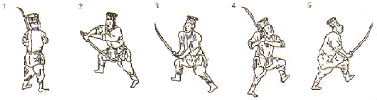
Tribal
martial arts (SahDoh MuSool)
The earliest
martial arts developed in Korea are referred to
as SahDoh MuSool; meaning tribal, clan, or family
martial arts, as this type of martial art was
mainly passed down from one generation to the
next through family lines.
SahDoh MuSool was popular among the ancient tribes,
city-states and smaller kingdoms that formed in
the Korean Peninsula and parts of what is now
China. This was evident well before the first
unified Korean kingdom of Ko-Cho Sun which was
founded in 2333 BC by the legendary king, DahnGoon
WahngGuhm. Later, SahDoh MuSool was further developed
and made widespread by voluntary militias comprised
of the common people, who often fought in battles
to defend their villages.
Traditional athletic activities such as Taekkyon,
and Ssireum are considered to have originated
from SahDoh MuSool. In fact, many techniques found
in the popular Olympic sport of TaeKwonDo can
also be traced back to SahDoh MuSool.
Buddhist martial arts (BoolKyo MuSool) Since
Buddhism was first introduced to the kingdom of
Koguryo in the year 347, a rather unique form
of martial arts was developed by both Buddhist
monks as well as martial artists, known as BoolKyo
MuSool.
Buddhist monks originally developed and then practiced
BoolKyo MuSool to improve their health while meditating
and to defend themselves while traveling.
As a result, Buddhist martial arts include both
internal training, with emphasis on special breathing
and meditation methods, as well as external training,
with emphasis on extremely effective self-defense
techniques. Many Buddhist monks were so accomplished
as martial artists that they were occasionally
called upon during national emergencies to fight
in battles by forming unprecedented armies of
warrior monks.
To this day, BoolKyo MuSool plays a significant
role for Korean martial artists by providing them
with philosophies of non-violence and compassion
as well as ethical codes of conduct, such as the
famous Five Precepts of the HwaRang warriors.
Royal
court martial arts (KoongJoong MuSool)
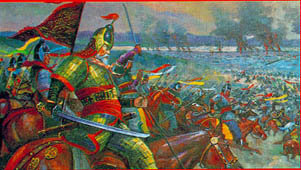 Kings,
royal families and government officials had private
armies and bodyguards who practiced a type of
martial art known as KoongJoong MuSool.
Kings,
royal families and government officials had private
armies and bodyguards who practiced a type of
martial art known as KoongJoong MuSool.
These royal court martial arts gave rise to esoteric
techniques of easily portable weapons such as
short swords and folding fans. Also developed
were unique weaponless techniques of joint-locking
and pressure point striking.
Existing records in Japan suggest that many KoongJoong
MuSool techniques found their way there and gave
birth to the Japanese art of Jujitsu.
King JinHung of the Kingdom of Silla encouraged
the HwaRang warriors to practice KoongJoong MuSool
in addition to their other martial arts training.
But later during the Koryo Dynasty and Chosun
Dynasty, Korean kings enforced policies to discourage
the practice of martial arts and to forbid the
possession of weapons, in order to protect themselves
from military rebellion or any other political
uprising.
However, Korean martial arts have continued to
develop both within and without the royal courts,
thanks to the efforts of many dedicated Korean
martial artists to practice, record, and compile
these precious martial art techniques.
Traditional
Korean martial arts (Kuk Sool) The three
branches of traditional Korean martial arts: SahDoh
MuSool, BoolKyo MuSool, and KoongJoong MuSool,
were organized to form a single system known as
Kuk Sool in 1958 by In-hyuk Suh, the founder and
Grandmaster of Kuk Sool Won™.
Kuk Sool has countless techniques derived from
the three branches of traditional Korean martial
arts and is structured to take a practitioner
in a logical progression from the beginning all
the way up to Master level.
Kuk Sool Won¢â has been actively promoted worldwide
by the World Kuk Sool Association™, and it is
also recognized in the martial arts community
as one of the most effective and comprehensive
systems of traditional Korean martial arts in
existence today.